




Only Sabahans should form state gov't, says SAPP
GE13 WATCH If a peninsula-based party leads the Sabah government, it would be tantamount to putting the state under Putrajaya’s direct control, according to Sabah Progressive Party (SAPP) president Yong Teck Lee.
For this reason, said the former Sabah chief minister, only local parties should lead the state government.
GE13 WATCH If a peninsula-based party leads the Sabah government, it would be tantamount to putting the state under Putrajaya’s direct control, according to Sabah Progressive Party (SAPP) president Yong Teck Lee.
For this reason, said the former Sabah chief minister, only local parties should lead the state government.
Yong, who is all for state autonomy, was defending his party’s bid to contest the lion’s share of seats in the state assembly, in the face of the interest registered by Pakatan Rakyat.
 “A Sabah government appointed by Kuala Lumpur would be subservient to the federal leadership... although they say that legally it is the governor who appoints the chief minister, it is the Umno or BN chairperson who appoints the Sabah BN chairperson, from which the chief minister and therefore the (state) cabinet, are also appointed,” Yong said in an interview.
“We say this goes against the spirit and the letter of the Malaysia Agreement and the constitutional arrangements. The party process subverts the constitutional process. If it were PKR or Pakatan Rakyat, it would be the same.”
The 1963 Agreement formalised the establishment of Malaysia by unifying Malaya, Singapore, Sabah (then North Borneo) and Sarawak.
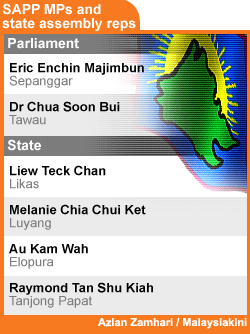 SAPP was initially involved in the six-party seat negotiations with Pakatan and state opposition parties Pertubuhan Pakatan Perubahan Sabah (PPPS) and APS (Angkatan Perubahan Sabah). Each party was to contest 10 of the 60 state assembly seats.
However, the negotiations turned sour after SAPP asserted that local parties should contest the majority of the state seats, while the majority of the parliamentary seats could be left to the Pakatan parties to give the coalition a better chance of forming the federal government.
In addition, PPPS and APS do not count as parties in the election, Yong argued, because the Registrar of Societies does not recognise them as political parties.
Therefore, the two would have to contest under the PKR banner - and that would mean PKR contesting in 30 state seats and not just 10.
 He slammed PKR for preaching greater autonomy for Sabah and Sarawak in its Kuching Declaration, yet wanting to hog 30 state seats.
“Why not use my party symbol?” Yong said, in jest.
PKR de facto leader Anwar Ibrahim (right) had previously complained that SAPP was stalling on the seat negotiations by demanding 40 state seats, which he said was unreasonable.
A day after the interview, Anwar gave up on the impasse.
He announced an end to the negotiations with SAPP “because time is short” and said he would continue to deal with PPPS and APS.
‘Time ripe to seek autonomy’
Yong defended his demand for 40 seats, saying that he is even willing to share these with a rival pro-autonomy party, the State Reform Party.
He said he has the resources to campaign in all 40 seats and that the time is ripe to advocate an autonomous state of Sabah.
 “When we saw the window of opportunity caused by (the political) ‘tsunami’ of March 8, 2008, the power equation was no longer such that Sabah and Sarawak are dependent on (the peninsula) for strong (state) governments,” Yong said.
After speaking to the Pakatan leaders, he said, he found out that they have no confidence in wresting control of Sabah from Umno in the coming general election.
Instead, they hope to win enough parliamentary seats to form the federal government by cooperating with political parties in Sabah and Sarawak.
After winning Putrajaya, Yong said, PKR hopes to trigger an exodus of Umno-elected representatives defecting to PKR or PAS, thereby allowing the coalition to takeover Sabah as well.
“So it will (result in) another ‘Umno’ government in Sabah. Only if the state government is captured by state parties will the scenario change.
“A lot of the BN assemblypersons and MPs would then have an option, and some of them may even defect to a state party. That will give the state government more strength.”
 He is also sceptical that Pakatan, or any party that takes over Putrajaya, would willingly cede autonomy to any state.
This could only happen if the coalition has no choice – and this is part of the reason Yong insists that Sabah-based parties should contest in the majority of the state seats.
As an example, he pointed to Scotland, which was given autonomy over its finances when then British Prime Minister Tony Blair needed the Scottish Nationalist Party’s support. This came 300 years after the dissolution of the Parliament of Scotland.
Yong warned that if the next general election does not result in greater autonomy for Sabah, it might give rise to secessionist movements in the state. The grumbling has been gaining ground since the 2008 general election.
“If there is no autonomy, the next generation of Sabahans will go for independence... Already, we are hearing, and never before, young people in Sabah saying, ‘What for autonomy? Go straight for independence’...
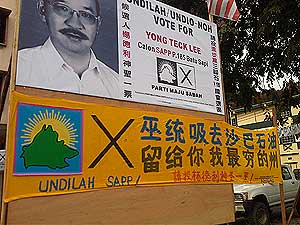 “If there is no autonomy granted to Sabah in the near future, more and more young Sabahans would go the other way - all the way for independence ... Even for me this is a little bit extreme, but it is very popular now.”
He clarified that SAPP merely wanted the state to be allowed to manage its own affairs and not to secede from Malaysia. As it is, he said, even changing bus routes require approval from Putrajaya.
Issues such as land grabs, poverty and marginalisation of native communities have been fuelling secessionist sentiments in the state, he added.
This has come to a head with the federal government's perceived ineptitude in defending Sabah from the incursion by followers of the ‘Sulu sultan’ - the stand-off at Lahad Datu dragged on for three weeks before the police and then the army intervened.


Are you sure you want to delete this comment?
This action cannot be undone.